
A resettled immigrant family navigates America
This is part of a series FSTN’s founder has created to share the stories of immigrants arriving in America as part of the now-shuttered USCIS refugee resettlement program. Every story in the series is available via Substack as part of Voices4Democracy’s series on immigration. . Part 1 overviews immigration in America. Part 2 features the story of a Syrian family, Part 3 features the story of an Afghan family, and Part 4 the story of a Sudanese family. Individuals from all of these countries are now all banned from obtaining immigration visas or resettling here as are individuals from 75 other non-European countries. These countries all have black and brown populations.
Arrival Day
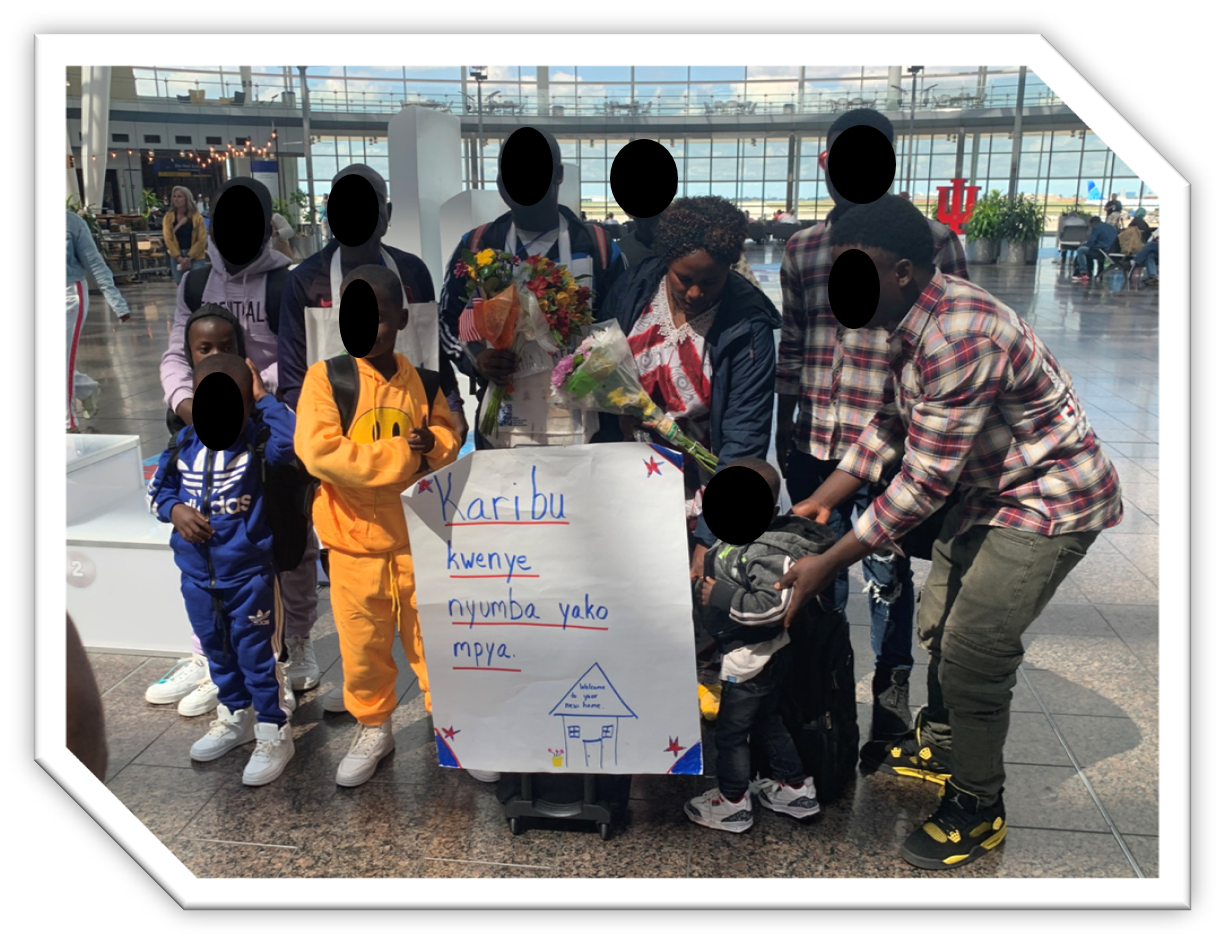
Arrival day in America! Just 2 1/2 years ago we greeted this legally resettled family with such hope. Today, we wonder if they will get to stay.
They are a family of 11. All boys. Their joy when they exited the terminal to greet our waiting team at the Indianapolis airport in July 2024 was palpable. The exhausted family had finally arrived in America. Life could begin.
Thanks for reading Voices4Democracy! Subscribe for free to receive new posts and support my work.
Their wait for resettlement was excruciatingly long: 14 years from the time Michel and Jeanne had fled with their three oldest children from the Democratic Republic of Congo (DRC) to the time they arrived stateside in Indy. In the interim, while they waited in a Burundi refugee camp, they would have seven more boys. A single article cannot do justice to all they endured in that 14 years or that they have overcome and accomplished since arrival here. Our lives in America bear zero resemblance to the lives of people who come from a country classified as one of the least developed in the world by the U.N.
DRC is home to 112 million people; 28 million - or 25% - face food insecurity. The country has endured ongoing civil conflicts since 1998 and, despite its rich resources, most of its population lives in poverty and lacks essentials most readers of this post take for granted: clean water, sufficient food, access to schools, access to healthcare, and more. DRC has been plagued by civil war for decades. Over 8 million people have been displaced in Congo as war destroys homes and entire communities. According to the United Nation Refugee Agency:
The DRC remains gripped by one of the world’s most complex displacement crises despite peace efforts. Decades of conflict, instability, epidemics, and climate shocks have uprooted millions, eroding livelihoods and deepening humanitarian needs…insecurity, armed groups, gender-based violence, and cholera outbreaks persist.
That is what Michel and his family fled in 2010. Michel and Jeanne’s sole focus was providing their children with opportunity for a future beyond violence and constant food deprivation. They wanted their children to have access to schools and be able to learn and thrive. Their oldest child, Emmanuel, had suffered permanent disability at age 1 because of lack of access to medical care. A high fever caused by a preventable disease led to brain damage and to partial paralysis on Emmanuel’s left side.
Creating a new home
Fourteen years after fleeing, the family finally found a new home: America. Two-plus years after that and we can see successes emerging from Michel and Jeanne’s tortuous journey toward a better life for their family. The family of 11 is housed in a 4-bedroom double that has about 1,400 square feet of space. The boys sleep 3 and 4 to a bedroom (courtesy of bunk beds) except for 27-year old Emmanuel whose disability earns him a tiny bedroom room to himself. The house features 1.5 bathrooms, which means a schedule for showering and brushing of teeth has to be strictly followed.
All the school-age children were immediately enrolled in school to start the school year in their age-appropriate grades: kindergarten (Bernard), 2nd grade (Pierre), 6th grade (Justin), 9th grade (Joseph and Francois). None spoke English at the start of the school year. All are excelling at their studies now and thriving in their schools. For the first time ever, the boys have had access to consistent, daily instruction and extracurricular activities such as soccer and music. This past summer, the older boys enrolled in a summer program on an urban farm where they earned $10/hour and participated in leadership development curriculum. The younger boys enrolled in the summer learning program at Dow-Wheeler Boys and Girls Club and learned to swim, an event that brought serious joy.
Smiles abounded when I delivered flip flops, waterproof bags, swim trunks, and swim goggles to the four boys who spent 8 weeks at Dow-Wheeler summer day camp. In addition to morning summer classes, the boys got to swim - something none of them knew how to do but were so excited to learn!
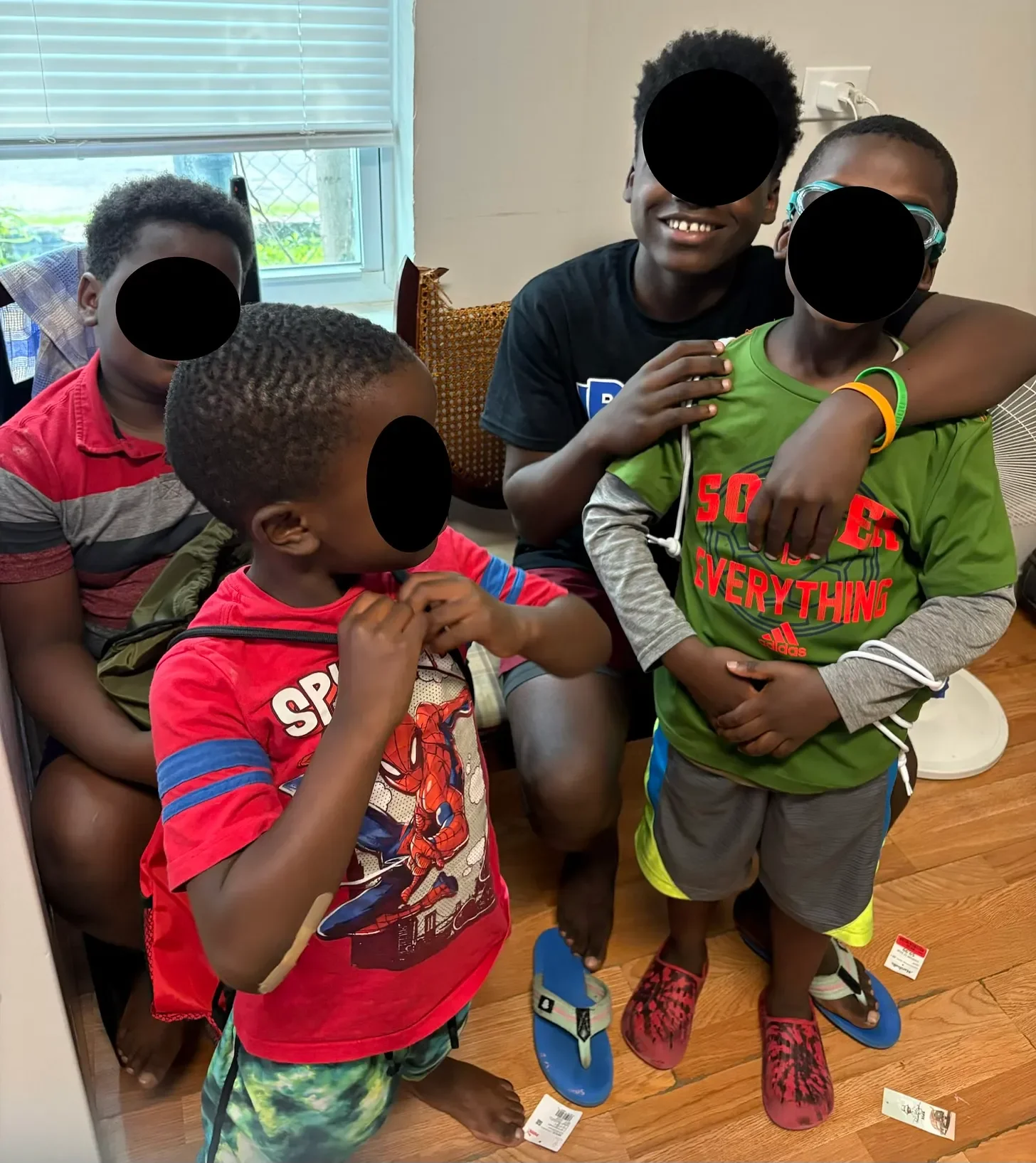
Smiles abounded when we delivered flipflops, goggles, towels, and waterproof bags to the four boys who would be attending Dow-Wheeler’s summer learning day camp - that included opportunities for twice-weekly swimming.
Slow, steady - and hard - progress
Michel and Jeanne’s journey has been marked with slow but steady progress, all of it a reflection of the couple’s intense effort. English is always the biggest obstacle and greatest need: jobs cannot be acquired without gaining at least a rudimentary grasp of it: being able to say and write one’s name, address, phone number and birthdate, being able to communicate about time, days of the week, being able to interpret a bus schedule.
And then there is the challenge of transportation: most of us take for granted the presence of a car and a driver’s license in our lives. Without those two things, the pool of available jobs shrinks considerably. One has to consider whether a job opportunity lies along a bus route and, if so, how long the journey might be. (Going even a few miles on Indygo can require a 30-minute bus ride. Rides across town require transfers and well over an hour’s time each way). Another huge factor is the hours of the job. IndyGo busses don’t make their first pickups of the day until 5 a.m. They stop running at 11 p.m., eliminating many jobs such as a FedEx job that begins at 4 a.m. or a maintenance job that ends at 11 p.m. (meaning you won’t make it to a bus stop by the 11 p.m. final pickup time).
Michel attained his first job in December of that year - a full five months after arrival. Until that time, the family relied on SNAP and TANF dollars to feed their family and to help toward rent. Medicaid covered their healthcare needs. The $2,000/month Michel brought home from that job didn’t pay for either one of those items: his monthly rent was $1,600. Their food costs - even using the thriftiest USDA guidelines - were around $2,800. From Strangers to Neighbors provided a rent subsidy of $1,000, leaving Michel to pay the remaining $600 out of his take-home pay.
With tremendous time and effort, Michel also earned a driver’s license, with a volunteer donating a car to him and FSTN paying his first 6 months’ insurance ($1160 for full coverage which Michel has since reduced to collision only as he is now paying for it himself). The car and license were game-changers. Michel took a job at a local FedEx with a starting time of 4 a.m. (no IndyGo bus running at that time). This 25-hour/week job paid $3.50 more an hour than his hotel job. He then acquired a full-time maintenance role at a local school, working 10:30 to 6:30 p.m. His second oldest son, 20-year old Daniel, also works at FedEx while attending Excel School part-time to earn his high school diploma. As long as no one gets sick or injured, the family’s financial situation has significantly improved.
A donated car from a generous volunteer is transformative for the family, dramatically expanding the family’s job opportunities. Constraints imposed by IndyGo’s bus routes and schedule disappeared.
Will they make it?
This family, given sufficient time and support, will become fully independent. The children will all graduate from high school. Most will likely earn college degrees. At least one has a deep desire - and the intelligence - to become a doctor while another wishes to become an engineer. All are incredibly talented, particularly in math, science, and music. But today? They need TIME. Self-sufficiency requires long-term support as a family builds the work history and skills needed to acquire better jobs, accrue a financial safety net, and gain education. Right now, they count on FSTN to provide a rent subsidy that enables them to put their wages toward food, maintaining their car, and gradually saving dollars to likely acquire a second car so older boys can have transportation to the jobs they will eventually get. They want to acquire a home of their own, something that will also take years of time to save for.
What will happen to them in Trump’s America is a massive question mark. Their Green Cards applications are now halted as is their SNAP and TANF aid, meaning they must depend on the donations from organizations such as ours to bridge the major financial gaps that remain between their income and their expenses. Right now, they rely on Medicaid for healthcare, something they will lose in a matter of months. The Big Beautiful Bill passed in Summer 2025 mandates that any immigrant family, regardless of legal status to be here, is not eligible to receive any social aid by year-end 2026. At the same time, the administration has halted all Green Cards processing for immigrants from most, if not all, non-European or non-white countries, leaving this family in a no-win situation. ICE has announced its plans to “re-vet” the status of all immigrants who arrived here under the Biden administration. Clearly the intent is to force some back to their countries of origin, even if those countries’ unsafe conditions remain unchanged.
America once championed human rights; this is changing
Historically, Americans viewed the United States as a country that stood up for human rights and valued being good humanitarians. From post-WWII, America had increasingly stood up for human rights as itgradually sought to right the wrongs of racism, gender discrimination, and sexual orientation discrimination within its own borders Citizens saw America as a country that provided opportunity and eventual prosperity to those willing to work for it. At the same time, America’s history shows we’ve consistently grappled with immigration and shown hostility to many immigrant groups.
In the early 1900s that hostility was directed toward Italians, the Irish, the Polish, the Chinese, and Jews. These immigrants had zero social safety nets in place to help them forge a hold in this country. There was no TANF, SNAP or Medicaid to help immigrants arriving here early in the 20th century. That lack of any safety net meant the generation arriving here dealt with poverty, disease, and early death. But it also meant there was tremendous entrepreneurship, the forging of strong immigrant communities who protected one another, and the education of subsequent generations who fueled America’s economy.
America got better as we aged. In the early 1980s we established the resettlement program that brought families like the Aberi’s to America. Prior to that, in 1961 we established USAID to provide humanitarian aid to developing countries like DRC, countries originally torn apart by colonialism perpetuated by white European countries.
America wanted to help people thrive and we wanted to demonstrate our commitment to human dignity and the idea that we could be a world leader in human rights.
Until we didn’t.
We decide America’s future
The current administration, elected into office in 2025, has targeted immigrants and immigration. The only immigrants currently welcomed into this country now come from white, European countries or South Africa. The administration claims its decision is rooted in a desire for the safety of Americans. In reality, it is rooted in a desire for a white-only America where immigration is limited to the wealthy few or to corporations who will pay dearly to fund the immigration of highly-educated engineers or technical skills.
This administration, along with a minority of MAGA voters, has decided it does not want to invest in people like the Aberi’s children or the other families featured in this series, even though ALL these families have demonstrated they will work hard to be in America and they can be positive contributors to American communities.
I do not believe that America’s official new stance on immigration is the stance of most Americans. However, it will take extraordinarily loud messaging to turn back the tide of anti-immigration policy and action. The Big Beautiful Bill has funded ICE to the tune of billions of dollars. This money is funding construction and operation of detention centers across America. MAGA Republicans are pushing hard on the anti-immigrant agenda.
How we the people vote in November 2026 will determine our future trajectory: democracy or full-on white Christian nationalist dictatorship. How we the people use our voices, our votes, and our presence determines the kind of America we will be.
_________
Sharon Boller is the board president of From Strangers to Neighbors.